


Analysis of reproductive health status, behaviors, and cognitive levels
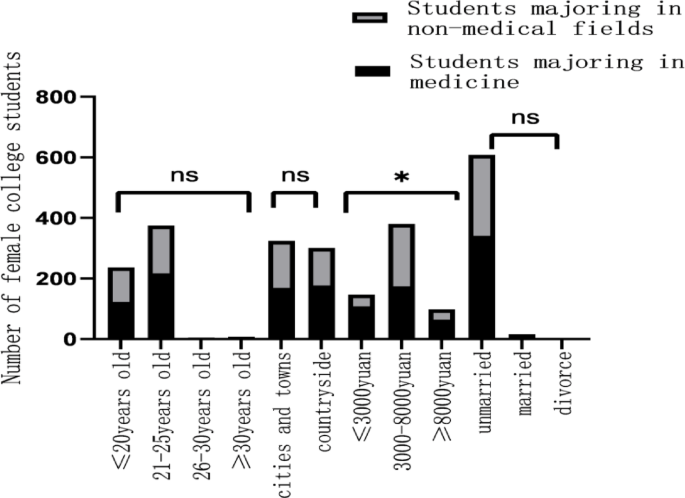
This study was conducted in three universities in Xinjiang, with a total of 625 participants, including female college students from various majors such as clinical medicine, preventive medicine, tourism management, statistics, history, and others, from the first to the fourth year. Overall, 73.4% of the participants had relatively regular menstrual cycles. However, the study found that 51.8% of the participants suffered from dysmenorrhea. When comparing different disciplines, the incidence of dysmenorrhea among medical female students was higher than that among non – medical female students. This is consistent with the findings in this study regarding the use of cold water during menstruation and the consumption of ice cream and cold drinks. Female students who consume raw and cold food and do not take warming measures are more likely to experience dysmenorrhea27. In addition, Lu Jingya et al. also found in their study that the incidence of dysmenorrhea among female college students majoring in medicine is relatively high. This may be because, compared with female students in non – medical majors, those in medical majors have a heavier academic burden and greater mental stress28.
Medical students shoulder heavy academic demands. They need to master a vast amount of professional knowledge and skills to get ready for future career challenges. This kind of prolonged intensive study can lead to a significant rise in mental stress. Stress, as a psychological factor, has been proven to have a connection with the occurrence of dysmenorrhea29. Moreover, the expectations and role definitions for medical students in socio – cultural contexts may also impact their reproductive health. In traditional concepts, the medical profession is often regarded as a high – intensity, high – stress field. This idea may push female university students in medical programs to more likely disregard or endure symptoms when facing physical discomfort, in order to meet the expectation of the “tough” image of medical students. These psychological and socio – cultural mechanisms not only influence their perception and response to dysmenorrhea, but may also further increase the frequency and severity of dysmenorrhea. In addition to psychological and socio – cultural factors, the irregular schedules of medical students may also negatively impact reproductive health. Due to heavy study tasks, they often can’t guarantee adequate sleep and regular meals. Such irregular routines can lead to endocrine disorders, thus increasing the risk of dysmenorrhea.
Overall, 17.2% of the participants had abnormal vaginal discharge, but there was no significant difference between different disciplines. Abnormal vaginal discharge is often caused by vaginal infections. According to the research results of Jiang Lijuan et al., long – term wearing of tight – fitting pants, synthetic underwear, and the use of sanitary pads during non – menstrual periods are prone to cause fungal vaginitis30. In this study, 52.2% of female college students chose 100% cotton underwear. Studies have shown that cotton underwear is a protective factor for the imbalance of vaginal microbiota in patients with polycystic ovary syndrome31. This may be because cotton products are hygroscopic and breathable, soft and comfortable, and less likely to breed bacteria compared with other materials.
The results of this study show that medical female students have better hygiene habits than non – medical female students. Medical female students are better than non – medical female students in wiping after each urination, wiping the anus from front to back after defecation, washing underwear separately, and undergoing gynecological – related examinations. This may be related to the systematic hygiene and nursing knowledge that medical students have received. Zhang Yan et al. also showed in their study that bad hygiene habits such as not wiping after urination, washing underwear together with other clothes, and using sanitary napkins for too long can cause infections in the female reproductive system32. Therefore, it is extremely important to develop good hygiene habits to prevent and treat reproductive system infections.
When comparing different disciplines, medical female students have a higher awareness rate of the concept of reproductive health than non – medical female students. Binary logistic regression analysis also found that awareness of the concept of reproductive health is a protective factor affecting the current status of reproductive health. Regarding common physiological knowledge and problems for both males and females, overall, the level of awareness among female college students is still relatively one – sided, which is consistent with the research results of scholars such as Li Luyao33. The survey results show that compared with male physiological knowledge, female college students have a better understanding of their own physiological knowledge. Therefore, it is possible to carry out popular education on physiological knowledge to make up for the knowledge deficiencies in this area. In terms of contraceptive knowledge, only a small part of the research subjects know that emergency contraceptives will be ineffective if taken more than 96 h after intercourse. This is consistent with the conclusion pointed out by Liu Yuanyuan in his research that female college students have insufficient understanding of oral contraceptives and there are obvious misunderstandings34.
Main factors affecting reproductive health
The main factors affecting women’s reproductive health are risky sexual behaviors35, poor hygiene habits, major – related factors, social bad mores, economic conditions36, as well as the mother’s education level, place of residence, and sleep time37, childhood abuse, parental conflicts, etc38. In addition, some studies have pointed out that lifestyle habits can also affect the awareness of AIDS prevention and control measures39. The novel coronavirus can also infect the female reproductive system, thereby triggering a series of reproductive system diseases40.
This study only explored the impact of two factors – poor hygiene habits and major – related factors – on women’s reproductive health. Poor hygiene habits can increase the risk of reproductive system infections, leading to a gradual increase in the incidence of various reproductive system infectious diseases and AIDS. In terms of major – related factors, medical female students have a better understanding of reproductive health knowledge than non – medical female students and pay more attention to their own reproductive hygiene. However, no significant statistical differences were found in the current status of reproductive health. In a study conducted by Tao Xiangxiu et al., it was discovered that BMI can have an impact on primary dysmenorrhea41. However, no correlation between BMI levels and the incidence of dysmenorrhea among female college students was found in this study.
In Xinjiang, traditional views and cultural background remarkably impact women’s reproductive health education. As a multi – ethnic region, Xinjiang has significant cultural and lifestyle differences among its ethnic groups, which profoundly affect attitudes towards women’s reproductive health and education methods. In some ethnics with strong traditional views, reproductive health is a private topic. Families and schools are conservative in education, leaving students with few ways to get relevant knowledge. This causes non – medical female university students to lack reproductive health knowledge, and feel shame and silent when facing related problems.
However, medical female students, with systematic hygiene and nursing education, have better reproductive health knowledge and self – care awareness. This shows systematic reproductive health education can effectively improve students’ cognition and self – care consciousness. Thus, universities should consider the social and cultural background in reproductive health education, and adopt suitable teaching strategies for students from different backgrounds.
Recommendations for improving reproductive health status and cognitive levels in female college students and implications for education
Suggestions for Improving the Current Status and Awareness of Reproductive Health in Female College Students. First, conducting special reproductive health education is an important way to improve the reproductive health of female college students. Studies have shown that sexual knowledge directly and indirectly affects reproductive health behaviors42. Reproductive health education interventions have a significant impact on improving the reproductive health awareness of female college students43. Education departments and schools should cooperate with each other to increase the intensity of education and dissemination in all aspects44.Employ diverse teaching methods to boost student participation. Offering elective courses on female reproductive health can teach students how to monitor their basal body temperature, identify the characteristics of vaginal discharge, and perform breast self – examinations correctly. These measures can effectively prevent common gynecological diseases among female college students, such as menstrual disorders and reproductive tract inflammation, and promote their physical and mental health45.
Second, obtaining youth – friendly health services is crucial for ensuring the sexual and reproductive health and well – being of adolescents46. In other countries, there have long been evidence – based studies on the development, implementation, and evaluation of youth – friendly health services (YFHS). However, the research results show that most of the 115 indicators used to measure youth – friendly sexual and reproductive health services are not specifically tailored to the needs of young people47. Therefore, relevant departments should actively cooperate and formulate reproductive health service programs that meet the needs of different age groups, and include reproductive health – related projects in the physical examination programs for college students.Universities should collaborate with medical institutions to offer accessible reproductive health services.
Third, a management model should be established that includes planning, standardization and implementation, monitoring and management, as well as evaluation and assessment. This model will provide a favorable safeguard mechanism for the sexual and reproductive health of female college students. It aims to ensure a comprehensive improvement in their awareness of sexual and reproductive health, and to instill the concept of lifelong maintenance of sexual and reproductive health. The ultimate goal is to truly achieve the objective of universal access to sexual and reproductive health education for all female students during their university years48.Further explore the underlying factors influencing reproductive health – related behaviors and perceptions. Conduct longitudinal studies with expanded sample sizes to enhance the generalizability of the findings.
link