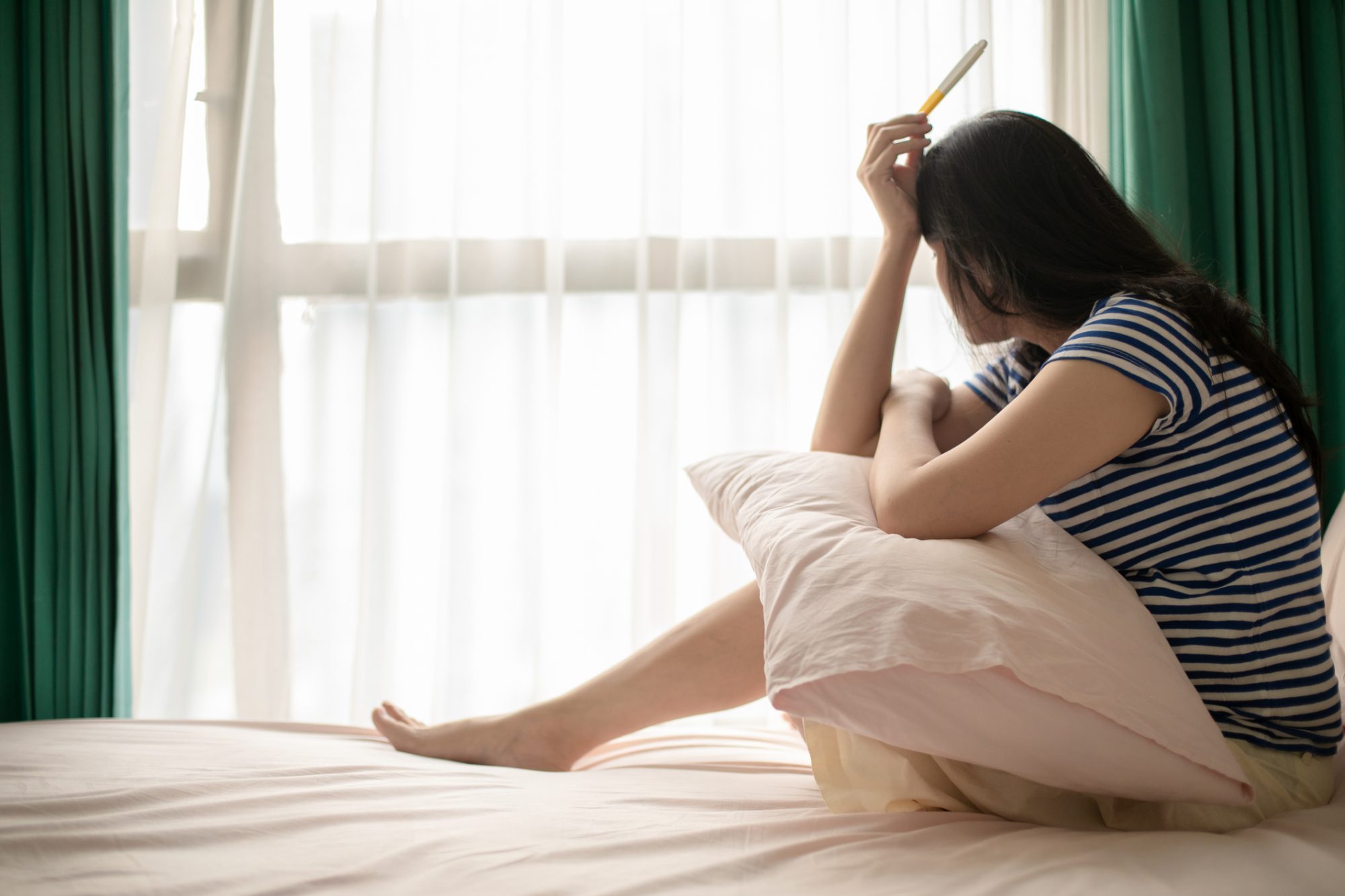
When a new mom sits across from me, vibrating with anxiety and certain that she alone is uniquely ill-equipped to parent, one of the first things I tell her, as a clinical psychologist specializing in treating perinatal mental-health disorders, is that she is in good company. A startling 20 percent of new mothers experience clinically significant levels of anxiety during pregnancy and the first year postpartum, and research indicates that the prevalence of perinatal anxiety is only increasing. Being a psychologist requires holding on to hope when your patients have none and metabolizing distress with a belief that, just as the moral arc of the universe is supposed to bend toward justice, we as a society will get better at caring for each other. But being an anxious mother in America seems overwhelmingly, uniquely bleak right now, with no hope of improvement.
My sessions are full of patients who describe feeling caught in a web of competing advice from self-proclaimed experts on social media. They cannot account for the hours spent falling down a rabbit hole of anecdotes on Reddit. AI has become such a ubiquitous companion for pregnant people that my intake for new patients now includes questions for me to understand how and why they consult ChatGPT. They admit that they don’t know how to walk away from their worries since becoming mothers. They tell me about doctors halfway out of the room before they’re done asking questions, and report that their partners are tired of repeating that, yes, the baby is definitely breathing in the bassinet. Left alone with their fears, they harbor a tender hope that they can protect their babies from anything and everything if they are good enough researchers. But what I see happening to my patients is not meaningful work to prepare for parenthood. Instead, it is a painful daily enactment of anxiety’s false promise that we can control our fate and protect ourselves if only we guess ahead of time where the danger lies.
These patients come to me to learn how to cope with anxiety while also contending with a nightmarish combination of a government that erases science and increasing reliance on unvetted internet resources for parenting advice. I used to be able to tell them where to find sound evidence-based guidance to answer their questions about how to keep their babies safe. I directed women with questions about what’s safe to consume during pregnancy to look at CDC or FDA websites that have since been bastardized by the Trump administration and, more specifically, RFK’s Department of Health and Human Services. I’ve told them to consult the “Safe to Sleep” pamphlets that are no longer being produced. In the absence of clear information, new parents increasingly turn to the internet to fill in the gaps. When a door closes a browser window opens.
There is nothing new about experiencing anxiety in the perinatal period because during pregnancy, there is a quiet reorganization of the brain that lends itself to worry. Like the bone-chilling horror movie trope, the call is coming from inside the house. Gray matter, neural material in the brain that is primarily designed to process information, shrinks, revealing a brain that is especially attentive and attuned to one’s baby. Pruning — the technical term for when evolution gets to work snipping away at underutilized neural connections so that the most needed cognitive pathways can flourish — is the brain’s way of catapulting us into new worlds of responsibility and meaning. For mothers, this means a brain that gets smaller (there is some debate as to what cognitive skills are impaired) in order to specialize in the care and keeping of her baby. Unfortunately, a brain primed for attention to one’s baby, in service of the evolutionary imperative to keep them safe, is also one that is prone to anxiety.
While I loved being pregnant, and felt thrilled to be part of this grand evolutionary magic trick, I was not immune to worry. When my patients list their worries, it feels like watching a grainy film of my own new-parent nightmares. Miscarriage, babies born sick, sudden infant-death syndrome — these concerns seem to be handed down by each graduating class of pregnant women to their successors. These preoccupations are not new, but I have a growing sense of guilt and sadness that I was pregnant in a brief golden window after the pandemic and before the disastrous second Trump administration that blocks our access to readily available, scientifically sound medical information to assuage anxiety. When I was pregnant, shoddy research claiming to have located a single cause for autism spectrum disorder had been resoundingly debunked. Vaccine schedules, for the vast majority of people, were regarded as stable, trustworthy guides. The FDA clarified that antidepressants are a lifesaving and reasonable intervention for pregnant and nursing women suffering from depression. The medical community was clear that formula is an acceptable alternative to breast milk. How quickly — how catastrophically — things have changed.
In the past year, panels of so-called experts (light on qualifications and emboldened by ulterior motives) have declared that medicating depression during pregnancy is dangerous. Trump warned pregnant women against taking Tylenol lest they give birth to a neurodivergent child, proudly citing his personal “common sense” as evidence that should outweigh decades of research affirming the safety of acetaminophen during pregnancy. RFK waxed poetic about breastfeeding as the only right way to feed one’s baby. Faux concern about health is a capacious Trojan horse — authoritarianism, misogyny, racism, and anti-intellectualism all comfortably nestle inside — and there seems to be no end in sight for this regime’s interest in making motherhood as dangerous, limiting, and physically and psychologically painful as possible. In an era when cartoonish levels of villainy are ubiquitous, you could not design a more perfect population — with their minds newly designed to worry — to torture with misinformation.
I have yet to meet a mom in my personal or professional life who has not laid down her worries at the altar of the internet, hoping for salvation and a little bit of sleep. This summer I found myself in a hypnotic loop trying to describe a mark on my son’s arm to Google: “Looks like mosquito bite, not itchy? Toddler arm red? When to go to the doctor about a rash? Different kinds of bug bites?” As the night wore on, my search history took on an increasingly frantic, abstract quality. “Is this okay? Will he be okay? Tell me everything is okay!” Anxiety tells us that mental rehearsal of disaster will somehow protect against the perpetual possibility of danger; this framework is often a recipe for obsessing but is especially painful when there aren’t trustworthy resources to call upon — either in the form of a well-informed community of caregivers or a government that takes science seriously. Typing our worst-case scenarios into search bars and asking large-language models to answer all our what-ifs is not protective; it is suffering dressed up as strategizing.
Large-language models and online resources are not inherently problematic (I am an advisory-board member of a company called Riley to create a parenting app that provides expert-guided, clinically backed guidance with an eye toward minimizing perinatal anxiety). But there are unique challenges to engaging with untrained AI from an anxious stance. ChatGPT is not a seasoned pediatrician used to diffusing parental anxiety or a static guide published by the American College of Obstetricians and Gynecologists. Instead, LLMs are sycophantic and happy to be invited to the party. They readily engage with an anxious patient when a person — perhaps a psychologist — would gently invite them to step away from the anxiety.
By the light of day, I could see a toddler arm that looked completely normal and a mother who thought she needed to become an entomologist but really just needed a hug. I think this is ultimately the trap my patients — and I — have fallen into. We miss the imperceptible point of transition from seeking information to needing reassurance. I remember, as a child, approaching my mother like she was a human crystal ball. Willing her to assuage my latest anxiety — what would camp be like? When would the power come back after a snowstorm? Would they like me at the new school? Why do my legs hurt? — with a perfect answer. But, much like a vampire after its first taste of blood, my anxiety regarded a taste of engagement as an invitation to ask for more, more, more follow-up questions. Had my mother considered this specific terror? And, sure maybe A, B, and C wouldn’t happen, but wouldn’t she like to address X, Y, and Z? Inevitably, my mom would reach a point of no return — no longer willing or able to answer my questions — and gently say, “I’ve told you everything I know; you’ll be okay.” I hated this moment as it marked an unceremonious end to the conversation, but it was exactly what I needed: a reminder that neither of us could tell the future. The best I could do was exhale and tell myself I’d probably maybe be kind of okay. Information is power, it’s true. But it’s not a panacea. We also need a sense of being witnessed and supported so that we can feel capable.
These days, I find myself wanting to replicate this moment with my patients and to teach them (and remind myself) that if a question has been asked and answered, what lingers is just worry and what’s needed is care. Research consistently indicates that social connections are a bulwark against perinatal anxiety, but the proverbial village we’re told is needed to raise a child is empty. In order to take care of new parents in their worry, we need a community enlivened by parental leave, affordable housing, quality health care, grandparents who can retire. And for the parenting questions with finite answers — what to avoid during pregnancy, how to dress a baby for the cold, when to go to the pediatrician — we need a mechanism or community that can ensure solid, evidence-based resources are accessible. Mothers need a way to scratch the itch of a brain that is made to wonder without getting stuck sifting through endless amounts of online resources looking, like Goldilocks, for the answer that feels just right. Once we alleviate the anxiety and sense of isolation that new mothers experience in a post-scientific, chronically online world, they can get back to exploring the best parenting questions, the really interesting and meaningful ones, that require community, not clicks, to answer. Questions like: What kind of mother do I want to be? How can I support my child in all their exquisite individuality? What’s our next adventure?
link