Study area and respondents
The study followed a qualitative research design which is primarily used to enhance knowledge of the topic that needs to be known better42,43. This research was carried out in the Sylhet City Corporation area since construction-related research in Bangladesh has been conducted predominantly covering the capital city, Dhaka, due to its rapid urbanization and high construction activity44,45,46,47. To bridge the gap between the capital city and other areas, the researchers deliberately selected this region. The Sylhet City Corporation area is 79.50 sq. km with a population of approximately 1 million across 42 wards48. During fieldwork, many building projects were found underway in various Wards of the City Corporation area. However, the building authorities restricted access to several building sites. Initially, the study included participants from six sites in four Wards. Then, based on the scholarly suggestions of five qualitative research experts, the researchers included three sites from two additional Wards to strengthen the study results and enhance the overall argument. Table 1 provides information about the sample area along with respondents’ numbers.
Purposive sampling was used to obtain data from respondents since it is a means of selecting a sample based on the judgment of the researcher. Workers having at least 2 years of experience in this sector were included in this study anticipating that experienced workers would have a deeper understanding of health risks and safety issues than the fresh workers. This strategy facilitates the researchers to explore a comprehensive view of the OHS of construction workers in Bangladesh. A total of 71 workers were identified to be eligible for participation; however, 50 workers consisting of both males and females participated. The researchers also invited all contractors and building owners of the selected sites to participate as key informants, but only 6 contractors and four building owners gave consent for participation. Table 2 provides the key demographic information of all respondents who participated in this study.
Data collection techniques and tools
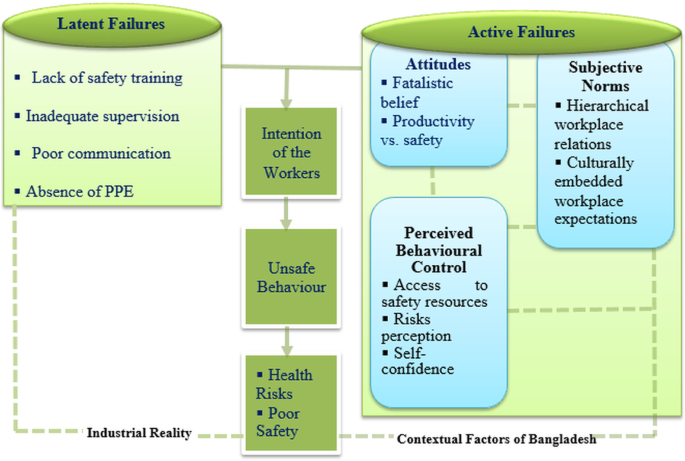
The researchers conducted IDIs with construction workers and KIIs with contractors and building owners to collect data. A checklist and two sets of interview guidelines—one tailored for contractors and another for building owners—were designed in alignment with the theoretical framework illustrated in Fig. 1. During preparing the checklist, issues were included being guided by the theoretical framework. For example, several questions were asked to know management deficiencies including “Are you pressured by your contractor to work longer hours or perform more tasks?”, “Why do you not use helmets and gloves at work?”, “Have you ever received any safety training for your work?” and “Does your contractor instruct you before starting any risky tasks?” To explore the enforcement of safety measures, questions like “Are PPEs provided to you?” and “Does your contractor monitor your work?” were included. To explore the psychosocial factors, a few questions were included like, “What do you personally believe about the importance of safety in your work?”, “How do you consider PPE for your safety?”, “Why do you not follow safety practices at work?” and “How do workers typically react when someone experiences an accident?” To understand fallible decision-making and behavioural intentions, questions such as “What kinds of work do you complete using shortcuts, and why?”, “How often do you work in risky conditions?” and “Do you anticipate the risks before starting hazardous tasks?” were included. Prevalence and nature of health-related risks were reflected in the questions, like, “Have you experienced or witnessed any injuries at site?”, “How often do accidents occur at your workplace?” and “How did you manage while experiencing injuries?”
Similarly, interview guidelines included the questions, such as “Why do you not arrange safety training or awareness programs for workers?”, “How do you communicate with workers?” and “Why do you remain absent at site?”, that revealed management-level deficiencies. To assess perceptions of workers’ attitudes toward safety, questions like “How would you describe workers’ attitudes toward safety on-site?”, “What do you think are the reasons workers are not genuinely committed to safe work practices?” and “How do you address workers’ neglect of safety protocols?” were incorporated. The question “What safety measures do you take to ensure worker safety?” was used to examine existing defence mechanisms. To understand risk behaviours and health-related hazards “What safety risks have you observed on-site?” was asked.
The first author prepared the tools in consultation with the second and third authors. Subsequently, the first author conducted interviews with three workers and one contractor to assess the tools’ effectiveness in eliciting appropriate responses from participants. The first author then shared these findings with the second author, who emphasized the need to address cultural and contextual issues. The refinement and revision of the tools were made based on the second author’s feedback. Data collection was accomplished solely by the first author with the assistance of a data collector. The first author asked the respondents and the data collector wrote the responses of the participants besides recording the interviews. Interviews with workers lasted between 30 and 45 minutes and the length was 60 minutes with contractors on average. However, the building owners were interviewed longer time than both contractors and workers. During fieldwork, the researchers conducted both IDIs and KIIs with those who showed willingness to participate in the study. Female respondents did not feel comfortable being interviewed at work, so they were interviewed at home. Since male workers were staying in makeshift tents built on-sites, they were interviewed in their tents during off time.
Data analysis
In addition to taking written notes during the interviews, all sessions were audio-recorded using a mobile phone. Upon completion of each interview, the recordings were transcribed by the interviewer. To ensure accuracy and evidence-based analysis, the transcribed data were cross-checked with field notes. The inductive analytical approach was primarily adopted being guided by the theoretical model of this study. Themes were generated after careful reading of verbatims making alignment with the theoretical constructs used in this study. In the analysis of health-related risks, abstractions from the participants’ narratives were highlighted. While examining participants’ statements regarding occupational safety and workers’ safety beliefs, deeper insights and structural factors were uncovered. The study employed Braun and Clarke’s49 six-phase framework for thematic analysis, which provided a systematic and rigorous approach. First, the researchers engaged in repeated reading of the transcripts to become familiar with the data. Second, initial codes were generated, focusing on concepts relevant to TPB and accident causation theories. Third, related codes were grouped to construct preliminary themes, with careful attention paid to identifying patterned meanings. Fourth, these themes were reviewed and refined to ensure alignment with the research objectives and theoretical underpinnings. Fifth, clear and meaningful headings were assigned to each theme. Finally, the confirmed themes were used to structure the findings of the manuscript.
Initial coding was made by reading line-by-line to capture descriptive and interpretive insights. These initial codes were then organized into conceptual groupings such as “types of occupational health risks,” “types of occupational health diseases”, “organization of work”, etc. Through iterative discussions within the research team, these grouped codes were further refined into analytically coherent themes, including Understanding Health Risks, Critical Factors of Safety, Construction Workers’ Safety Beliefs. This analytical process is illustrated in Table 3, which demonstrates the pathway from raw data to final thematic categorization. Thematic saturation was reached when no new themes emerged from ongoing data collection. While initial coding commenced after the first 10 interviews, by the 40th interview, the data began to repeat existing patterns without contributing substantially new insights. Nevertheless, all 50 IDIs and KIIs were included in the final analysis to capture the diversity and richness of participants’ experiences. Researchers’ reflexivity was maintained throughout the study. The first author, who conducted all interviews and led the coding process, brought prior academic and contextual familiarity with occupational health issues in the Bangladeshi construction sector. To strengthen analytical reliability, the second and third authors, who were not involved in data collection, independently reviewed the codes and thematic framework. Their critical input, combined with several rounds of discussion and refinement, ensured that the themes were conceptually sound, empirically grounded, and not unduly influenced by the first author’s positionality.
Verbatims were selected to accurately express the sentiments, experiences, and latent meanings of the narratives50. This thematic analysis was appropriate for the study context, enabling a theory-driven analysis that both explicated the underlying ideas in participants’ narratives and depicted a picture of ground-level realities of OHS experienced by construction workers in Bangladesh. The third author guided the selection of appropriate verbatims from respondents’ narratives to increase the readability of the identified themes.
Research ethics
The study was conducted following the ethical guidelines of the Research Center of Shahjalal University of Science and Technology, Sylhet, Bangladesh. The study was conducted as part of a Master’s thesis, completed over three semesters. The research protocol, including the study design, data collection instruments, data analysis, and ethical considerations, was reviewed and approved by the respective institutional review committees at multiple stages of the timeframe. In the first semester, the first author developed the research proposal, which was formally presented before a review committee and it approved the proposal. In the second semester, the author conducted an extensive literature review, identified the research gap, and developed research instruments. These were also reviewed and approved through departmental procedures. In the final semester, the first author collected and analysed the data, prepared the thesis report, and successfully presented the findings in front of scholars. Each phase of the work was rigorously evaluated by the supervisor and respective institutional committees. Informed consent was taken from the participants as it provided an extended opportunity to ask questions51. It was taken verbally from respondents because many were illiterate and fearful of giving written consent. Data collection tools were pretested and reviewed to avoid questions that could create conflicts or hurt anyone of the respondents. Voluntary participation of respondents was ensured. They have been given the opportunity to quit the interview anytime they wish. They were given assurance of maintaining the confidentiality of their information. The anonymity of the respondents has been maintained.
Limitations of the study
The study, conducted using a qualitative methodology, has limitations. The findings, based on narratives of the workers from a specific region, may not be generalized across the entire country. The unequal participation of male and female workers could affect the robustness of the findings. Future research should employ a more extensive and representative sample size, including various worker segments, and utilize advanced statistical analyses to produce more valid and reliable results. Additionally, future research could delve into the impact of safety beliefs on safety practices to propose robust recommendations for ensuring the safety of construction workers.
Results of the study
Results have been presented in three sections; understanding health risks, critical factors of health safety, and construction workers’ safety beliefs.
Understanding health risks
This study finds various occupational injuries and diseases among workers that are shown in the Table 4 with extracts from the statements of the respondents of this study.
Critical factors of health safety
Occupational health safety in the construction sector is profoundly impacted by safety training, safety education, PPE, contractors’ supervision, organization of the work, and contractors’ communication with workers. These factors are described in the following.
Safety training
It is essential to provide safety training to enhance workers’ skills and ensure safety at work. However, the construction industry lacks a fundamental understanding of occupational safety. Workers highly value safety training for its role in enhancing workplace efficiency and ensuring safety. However, some contractors prioritize hiring experienced labourers over investing in safety training. This practice frequently results in increasing the chances of workplace injuries. One respondent recounted a personal incident:
I was assigned a task of cutting rods using a machine, which I had never performed before. I connected the machine by plugging it into an electric socket, and after some time, the wire was unexpectedly pulled, causing the machine to spark, which resulted in eye irritation.
While inexperienced workers are more susceptible to workplace accidents and injuries due to unfamiliarity and lack of skills, experienced workers may face risks due to self-complacency or overconfidence. An experienced worker shared:
A co-worker with nearly a decade of experience in construction was quickly laying bricks on a wall. After building a wall about two feet high, the entire structure collapsed, causing a serious injury to his leg. He has been absent from work for several days due to this injury.
Inadequately secured formwork, which supports concrete during construction, or incorrect masonry techniques can not only cause delays but also greatly increase the chances of injuries. Furthermore, untrained or inadequately trained workers often lack fundamental understanding of masonry techniques, which not only causes construction delays but also disrupts the workflow. Another worker described the challenges of transitioning to a new role on an unfamiliar construction site:
As a newcomer to this site with no prior urban construction experience, I faced many difficulties adapting to the work environment. Previously, I assisted in carrying concrete. Due to lack of fundamental knowledge about concrete mixture ratios, initially I was puzzled and made errors in mixing.
This example highlights the potential outcomes of insufficient construction training, which not only puts the stability of buildings at risk but also endangers the long-term health and safety of construction workers.
Safety education
Construction workers generally lack formal education and receive no training on occupational safety, leaving them largely unaware of health risks and best practices for on-site safety. One employer noted that:
The absence of formal safety training renders workers unaware of essential health protections. This deficiency also reduces their motivation to adhere to safety protocols on site.
In this sector, employment practices worsen these issues as contractors informally hire workers without considering their educational backgrounds or prior safety training. New hires are rarely provided with job-specific training or safety awareness initiatives. An experienced labourer explained:
Contractors often employ new workers based on verbal agreements, permitting them to start work immediately without any preliminary safety orientation. These workers begin with limited or no understanding of how to protect their health on-site, as contractors prioritize physical readiness over safety knowledge. This lack of attention results in a higher risk of injuries and accidents.
It is clear that workers need safety awareness as it greatly impacts their compliance with construction protocols and helps reduce exposure to hazardous conditions. As another worker expressed:
Building safety awareness among us is crucial; it encourages adherence to safe work procedures and reduces suffering from various adverse situations.
Senior workers recognize that the absence of safety education and awareness directly leads to unsafe practices and OHS difficulties. Reflecting on this, one labourer shared:
Construction work is inherently risky and requires constant vigilance. However, many of us only grasp this after experiencing injuries. This occurs largely because most workers have little or no formal education, making them unaware of workplace health and safety.
Occasionally, informal discussions between contractors and workers address job expectations, but these rarely cover safety considerations. A worker recounted as follows:
The contractor instructed us to expedite the work but did not mention anything about safeguarding ourselves from injuries or accidents. We are compelled to prioritize survival over safety. Raising safety concerns can lead to termination, so we cannot focus on avoiding hazardous situations.
Owners agree that workers are being inattentive and facing increased risk because of the lack of safety education and awareness.
Personal protective equipment (PPE)
PPE is crucial for safeguarding construction workers from various health hazards. Training on PPE usage is essential to improve worker safety compliance, as one building owner noted:
Educating workers on the importance and correct application of PPE would increase their willingness to use it and enhance workplace safety standards.
However, the supply of PPE is largely dependent on the discretion of individual contractors in Bangladesh.
Contractors provide PPE only for specific high-risk tasks. However, contractors blame workers for not using PPE. One contractor mentioned,
I supplied helmets, gloves, and boots for workers during casting work on a building roof, but workers are unwilling to use PPE Some workers found the gloves uncomfortable, making their hands feel heavier and limiting finger movement.
Echoing the above statement another contractor shared:
Workers are reluctant to use helmet because it restricts the easy mobility of head, slowing down their work.
These statements highlight the workers’ lack of safety awareness, resulting in risky behaviors and a reluctance to use PPE. Workers do not agree with contractors. Confronting contractor statement, a worker noted that contractors’ frequent harsh behaviors and pressure lead them to complete tasks quickly, which discourages adherence to safety measures, like using PPE.
Contractors’ supervision
Expert supervision is crucial in preventing errors and ensuring operational accuracy in construction work. Contractors can offer immediate on-site supervision, giving direct guidance to workers. They manage several construction projects concurrently which limits their ability to comprehensively monitor every location. As a result, they prioritize their visits according to each site’s progress. One worker explained:
Our contractor is currently managing four sites. He visits our site every two days to oversee the progress. Recently, he has been visiting another site daily, where roof casting for a multi-story building is underway.
Another worker echoed a similar experience:
Our contractor primarily visits the site to check task completion rather than to offer on-the-job supervision. He stays in contact with senior workers via phone, providing remote instructions to guide them.
Each construction site poses unique safety risks. Continuous on-site supervision is vital for enforcing safety protocols and fostering worker alertness and caution during work hours. However, it is surprising that supervisors are rarely concerned about health and safety issues. A worker shared that:
Contractors sometimes pass idle time or engage in casual conversations rather than actively monitoring ongoing tasks to identify potential hazards.
Organization of the work
Maintaining an ordered workflow is essential for efficiency, safety, and cost-effectiveness. Despite the necessity, disorganized conditions at the workplace expose heightened safety risks. The lack of prioritization in task management not only causes delays in project implementation but also increases safety risks and financial losses for construction projects. A worker narrated his experience:
I was assigned to work on the staircase frame using metal rods which required a larger team with tools. Nearby, some masons were plastering, some were laying bricks on the basement wall who were assisting me in the beginning. When they returned to their respective tasks, I was bending a rod to form the staircase frame alone and got injured my hand at the hinge. It could not be happened if they were with me.
Contractors’ communication with workers
Effective communication between contractors and workers is essential for maintaining work momentum and fostering dynamic teamwork. However, during visits to the research sites, effective communication between contractors and workers with clear and purposeful message was found missing . Insufficient safety communication often leads to work-related injuries. One worker shared his experience:
I was instructed to switch off the grinder machine, but the switchboard was in a separate room. When I entered, my foot accidentally touched a faulty electrical line, and I nearly experienced electrocution.
This incident demonstrates how workers become vulnerable if they do not receive sufficient instructions. Workers, particularly subcontracting and substitute, often bear a high risk for lack of experience and minimal interaction. One worker noted:
Substitute workers tend to be reserved and often work without much interaction with the team and are more likely to experience accidents and workplace hazards.
Though contractors placed importance on safety communication, workers expressed deep concern for delayed or dismissive responses and the threat of job termination. Interpersonal communication between workers is crucial for identifying and mitigating safety risks in the construction environment. One building owner emphasized:
Communication between workers and -contractors are equally essential because it allows transfer of knowledge to encounter unwanted workplace hazards. It also prevents repeated mistakes, creates a supportive environment, and enhances the competency of workers.
Construction workers’ safety beliefs
Ensuring workplace safety at the construction sites is a multifaceted challenge. It is very often exacerbated by local workplace cultures that impede adherence to essential safety protocols. Contractors, who are primarily responsible for improving safety performance, often ignore safety regulations and do not provide any safety training. Workers are relied on informal practices as contractors provide makeshift safety measures. One building owner recounted the following:
I have witnessed a fragile state of workplace safety due to inadequate PPE. Contractors offer sandals for walking on uneven surfaces and debris, along with hats for protection from the sun or head injuries. I have also noticed workers placing folded handkerchiefs or similar items on their heads to provide support when lifting heavy loads. Contractors often supply rope ladders for workers to get access to the upper floors of buildings. While these measures are meant to be protective, they increase the risk of accidents.
Interestingly, workers show little concern about these inadequate precautions. In the study area, workers often perceive safety protocols as obstructive to fulfilling their target set by the contractors even though head injuries are a potential risk on the construction site. This decision may create a more comfortable work environment and help workers meet contractor-set deadlines. Additionally, the informal sharing of task methods among workers, along with their individual interpretations of task execution, often fosters negative attitudes toward following safety protocols, further exacerbating risks. One building owner shared the following incident:
Once two workers attempted to lift a heavy machine from the ground floor to the second floor. I suggested them to involve more workers, but other workers engaged nearby refused considering it as an easy task. Ironically two workers later complained about pain and stiffness in their lower backs.
This situation highlights the lack of managerial initiatives such as adequate supervision and communication, which leads workers to foster a poor safety belief. Moreover, workers’ reluctance to engage in safety practices is often fueled by their belief that workplace injuries and fatalities are inevitable. It resonates with the safety precautions at construction sites. The study also identified a tendency among workers to prioritize speed over safety, increasing the likelihood of accidents. One respondent recounted:
A fellow worker was cutting rods for a roof casting frame. Since many rods needed to be cut, he used an electric hacksaw to cut several rods at once, creating erratic sparks that caused eye irritation.
The influence of pressure from contractors or senior workers frequently compels junior employees to undertake precarious tasks. One worker shared his experience:
I was pressured to operate a vibrator machine to ensure proper mortar integration during casting, despite having no prior experience with the task. When I started operating the machine, it became stuck in the casting frame, and I strained my hinge.
Internal conflict among workers restrains them from making a consensus on safety issues and limits their collective voices. If senior workers impose something on junior workers that they are unwilling to do, it creates mistrust and conflict between them which in turn weaken their collective voices. In the absence of collective voices, they cannot place any demands for increasing their safety and security. Furthermore, constant fear of accidents may increase the safety risk. Like many others, one worker said:
We cannot anticipate the risks for lack of experience and proper guidance. when we decide to start a risky job, we continuously feel threat. It may often create insecurity and excessive fear which in turn increase the risk of injury.
link