Socio-demographic characteristics of the participants
As shown in Table 2, the mean age of the participants was 16 years. Most of the participants identified as Muslim (78%), Hindu (13%), and Buddhist (9.3%). The participants represented 10 different sports, with 78% engaged in high-physical-demand sports, including football, hockey, swimming, judo, and athletics, whereas 22% participated in sports with relatively lower physical demand, such as shooting, tennis, and archery. Most participants were in grades 10 and 9, with an average age at menarche of 12 years.
The mean age of the key informants was 44. Most (3 out of 6) were in administrative and coaching roles. Half were male. Three of the six key informants had more than 10 years of experience, as shown in Table 3.
Current menstruation management practice
The following sections explore the specific practices employed by the participants, focusing on their use of sanitary pads and oral contraceptive pills (OCPs).
Use of menstrual absorbents and hygiene products
Menstruation management practices among participants primarily involved using disposable sanitary pads, with some athletes also utilizing a combination of cloth and pads. Some preferred cloth for its softness, but due to concerns about irritation in genital areas and fears of cloth displacement, pads were predominantly used. Participants also shared their experiences during the COVID-19 pandemic, when cloth became more prevalent because of the unavailability of sanitary pads. Some participants mentioned using both cloths and pads because of heavy flow and prolonged menstruation. During the first two or three days of menstruation, participants used sanitary pads and switched to cloth for the remaining days. However, all the participants generally preferred sanitary pads over cloths because of the inconvenience of washing and drying. One participant shared her experience with cloth usage, recounting an incident where she was injured during menstruation while in the field. She said,
My cloth was displaced, causing menstrual blood to leak. With an injured hand, I was unable to wash the used cloth immediately, so I stored them (used menstrual cloths) in a bucket until I recovered. I used to dry clothes inside the room.
All the athletes reported using newspapers to wrap the used pads and dispose of them in the common waste bin, even in camps and tournaments.
Use of oral contraceptive pill (OCP) for delaying menstruation
Among the participants, only swimmers used oral contraceptive pills primarily to delay menstruation during camps or tournaments. However, none understood how OCPs worked; their coaches had limited knowledge about their proper use. Coaches from other sports did not emphasize the use of the OCP due to the concerns of participants’ reproductive health. One of the swimmers expressed her concern by saying,
Normance (name of the OCP) is used to stop menstruation, but in my case, I saw changes in urine color. I feel like blood went through my urine. It is not red but similar to red, a yellowish color.
Some participants mentioned experiencing pain after taking oral contraceptive pills (OCPs). They alleviated this discomfort by using a hot water sack. They attributed the pain to the OCP and did not receive specific instructions on when to start or stop taking it. Instead, they relied on advice from friends, typically taking the pills two days before a tournament and stopping after the event. They were unaware of any guidelines regarding the cessation of OCP usage.
Challenges
Three broad themes were developed to explore the challenges encountered by adolescent athletes in managing menstruation: (i) physical and health-related challenges, (ii) psychological and sociocultural challenges, and (iii) economic and accessibility challenges. Each theme is further explored through specific subthemes, emphasizing the multifaceted nature of these athletes’ challenges.
Physical and health-related challenges
Among the participants, 14 out of 32 mentioned experiencing stomach and waist pain as a common issue during menstruation. The majority of adolescent athletes were reluctant to practice for the first two to three days of menstruation. Some athletes reported being unable to move during periods of heavy flow due to the intensity of the pain and muscle cramping they experienced.
Some participants noted that their irritation affected their relationships with teammates, coaches, and overall team dynamics. Additionally, the participants mentioned experiencing itching in the genital area. Several adolescent athletes informed the housemaster about itching during their period. Based on her knowledge, the housemaster advised them to use hot water in the affected area. Fatigue and weakness were also reported, with participants experiencing muscle cramps and reduced running activity during menstruation. Figure 1 illustrates the physical challenges where all 32 participants mentioned their inability to engage in regular physical activity due to menstrual discomfort.
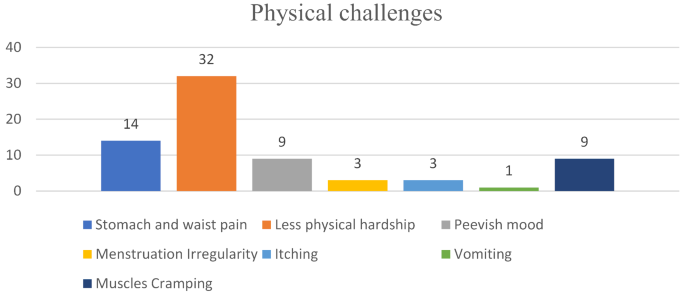
Physical challenges faced during menstruation
Coaches also observed that during menstruation, adolescent athletes were unable to train with the same level of physical intensity as on non-menstrual days. As a result, they faced challenges in maintaining fitness and skill. Coaches also mentioned that prolonged menstruation, defined as menstruation lasting longer than 7 days, was a major challenge for many athletes. They observed that some girls experienced menstruation multiple times in a single month, whereas others had only one period with gaps of two to three months in between. These irregularities were reported to affect their mental well-being. In addition, some athletes experience severe pain during menstruation, which can prevent them from engaging in exercise.
Coaches expressed concern that menstrual disorders could result in the loss of promising athletes. One of the coaches expresses her stress by saying,
“One of my best players has menstruation three times a month. I could not make her play. She is under treatment. Our medical team was not able to make her sound. Currently, she is under the treatment of a gynecologist outside of BKSP in her district. Her family bears the treatment cost, and she stays at her home. I am in doubt whether she can continue or leave the play”.
Another coach from swimming mentioned that their team holds 10 training sessions per week; missing practice due to menstruation disrupts the athletes’ progress, making it difficult to maintain swimming rhythm. All the swimmers talked about how missing sessions during their menstrual period affects their performance and disrupts their training momentum. They also mentioned that menstruation makes their bodies feel heavier and less flexible. To compensate for the missed sessions, they needed to practice more intensively during the remainder of the month; however, they did not receive additional time for these extra sessions.
One of the coaches raised concerns about the long-term impact of menstruation, noting that iron deficiency often begins during adolescence. This condition can reduce hemoglobin levels and the oxygen consumption capacity, which decreases energy and performance. However, it was unclear whether these observations were based on specific monitoring or the measurement of biomarkers such as anemia. The coach expressed frustration by stating that if a player was not physically fit due to these issues, she could not participate. It was not specified how coaches determine physical fitness or if student-athletes were routinely tested for anemia.
Lack of medical care
The lack of 24-hour access to medical professionals exacerbated the challenges of menstruation management. Students expressed hesitation in seeking medical assistance from male medical officers for menstruation-related issues. A coach mentioned that a female physician was recently appointed, replacing the previously male-dominated medical staff. Another coach noted that while there is a medical facility on campus, doctors are not available during all shifts. During individual in-depth interviews and focus group discussions, none of the girls mentioned receiving medical care for menstruation from the medical officer. Coaches also highlighted the medical officer’s insufficient expertise, citing an incident where some girls faced challenges with menstruation disorders, which the medical officer could not resolve. They took advice from a guest who was a gynecologist.
Psychological and socio-cultural challenges
Taboo and superstition
Certain taboos were observed among participants, influencing their dietary choices. Two-thirds of them refrained from consuming fish based on guidance from family members and seniors, who associated fish consumption with an unpleasant odor in menstrual blood. Although the hostel’s menu included fish, some girls discreetly gave their portions to friends during menstruation to avoid eating it themselves. Similar taboos were attached to eating meat, eggs, milk, and spicy food. Some participants avoided cold, icy items during menstruation, believing they could cause blood clots. One participant expressed concerns about the harmful effects of cold beverages, referencing a book, but being uncertain about the specifics. Regarding personal hygiene, many girls mentioned abstaining from using shampoo, a practice instilled by their families, with religious beliefs cited by one athlete. Despite attempts to maintain this tradition, sweating during physical activities complicated matters, adversely affecting their hair. Hindu participants shared their beliefs about the number of swastikas influencing the duration of menstruation. The swastika is a symbol of prosperity and fortune in the Hindu religion. She said,
My mother said to put three tika by my menstruation blood so that my menstruation does not last more than three days.
She reported that after performing this ritual during her first menstruation, her period typically lasted three days. Another girl mentioned that refraining from shampooing during the initial three days would keep the menstrual cycle consistent. One of the participants spoke about the limited use of acidic products during menstruation, as she learned from her mother that pH levels increase during menstruation. Using soap can further raise the acidity, as they believed soap contained acidic ingredients. Families advised against vigorous physical activities during menstruation, citing potential health risks, such as the uterus descending.
Several participants emphasized the importance of maintaining cleanliness during menstruation, as taught by their mothers, to prevent infections. Practice included using hot water and Savlon to clean the vaginal area during menstruation. Some girls mentioned drinking large amounts of water during menstruation, believing that increased urine flow helps “clear” menstruation more effectively. Others opt for fruit juice to replenish the blood they feel is lost during menstruation. All the taboos mentioned by the participants are presented in Table 4.
Barriers to communication
Pervasive discomfort exists when discussing menstruation-related matters, leading to hesitancy and shyness among players. While some sports benefit from the presence of female coaches, others lack this option, compelling athletes to share their concerns with male coaches despite reluctance. Most junior players preferred female coaches, who still grapple with residual shyness when they share personal concerns. They use the word “sick” to indicate menstruation. Most of the participants mentioned that when they approached their male coaches regarding menstruation issues, they were typically referred to female coaches. However, this process sometimes creates problems. As one of them said
Once in the academy, my menstrual blood started to leak, and I was confused. Initially, I mistook it for the usual white discharge I experienced, but later realized it was my menstrual blood. The flow was heavy, and I urgently sought out my female teacher. On that particular day, our school’s director-general (DG) was visiting, and our female teacher was accompanying him. I tried to inform my male teacher, but he deferred the discussion, saying it could wait. However, as my bleeding worsened, I could not return to the hostel to change without permission. Eventually, I managed to speak to a sir, but he instructed me to obtain a signature from Asma madam, the female teacher, before meeting with him. However, Asma Madam was preoccupied with the DG’s visit. Ultimately, I had to return to the hostel without adhering to the rules.”
Nearly all the girls mentioned reading the menstruation chapter in their textbooks, primarily in the ninth and tenth grades. Before that, they learned about puberty from their health education book. However, female teachers typically taught these chapters, often only briefly covering the material. Teachers instructed them to read the chapters independently and encouraged them to seek help if they had difficulties understanding the content. The adolescents found it challenging to ask questions in class due to limited opportunities, and these classes were typically conducted only once and never repeated. Additionally, the presence of boys in the classroom often led to laughter, making the girls feel shy. As one of the girls mentioned,
“Our teacher conducts the menstruation class, but she does not delve deep into the topic because there are boys in the classroom.”
Most athletes expressed dissatisfaction with the information provided in the textbooks, deeming it insufficient. They desired more comprehensive details, especially regarding dietary habits, nutritional requirements during menstruation, hygiene practices, sanitary pads or cloth use, recommended pad-changing frequency, typical blood loss levels, and potential health issues from inadequate menstruation management. Some athletes also suggested incorporating additional topics into the curriculum, such as menstrual rest, to facilitate obtaining leave from teachers.
Economic and accessibility challenges
Cost of sanitary pads
The challenges posed by the unavailability and high cost of menstruation pads were significant. During focus group discussions (FGDs), many girls highlighted the high cost of sanitary pads. To manage expenses, they resort to using cloth and reduce the frequency of pad changes, particularly in the later days of menstruation, with some using a single pad for 24 h. In addition, they expressed a need for tissues as a resource in their washroom and dressing rooms, which they could use on fewer flow days. Menstruation disorders or heavy flow require more sanitary pads; therefore, they said it would be beneficial if menstrual pads were supplied at no cost or at a low price.
Accessibility challenge
Many students reported experiencing sudden menstruation during classes or field activities, which often required them to leave for the hostel to access sanitary pads. It creates challenges. Athletes expressed a strong need for sanitary pad booths to be available in schools, colleges, dressing rooms, and hostels as a solution. Coaches supported this idea, noting that a central pad booth near washrooms could reduce absenteeism. The participants also emphasized the need for separate girls’ washrooms equipped with bins for proper disposal and handwashing facilities, preferring handwashing with soap. Currently, the number of shared bins is inadequate, leading to improper disposal of used pads.
link